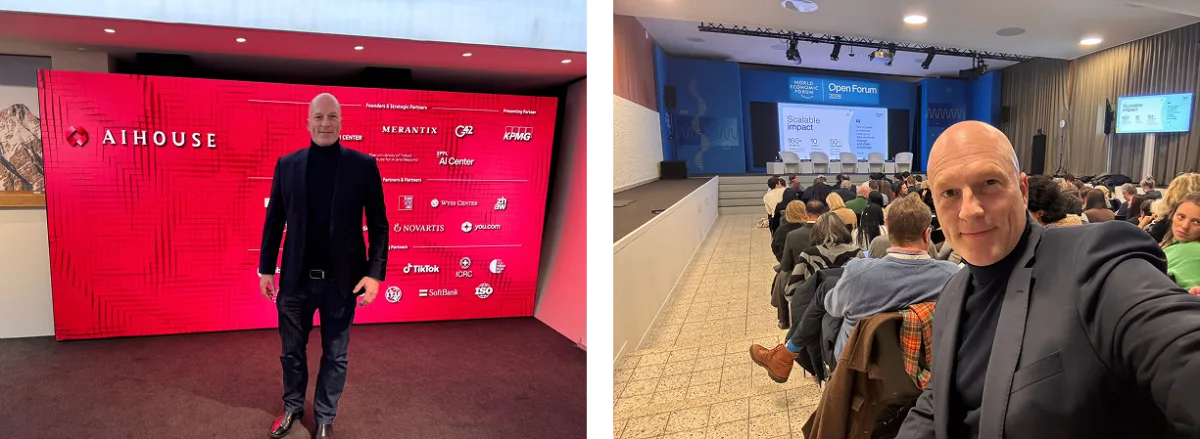
By Benjamin Eule & Dr. Noah Lee, Co-Founders, Gottlieb
We arrived in Davos with a hypothesis: AI for physical engineering requires fundamentally different approaches than the chatbots dominating today's headlines. We left with that hypothesis validated – but not in the ways we expected.
This wasn't our first rodeo with transformative technology. Between us, we bring decades of experience: Benjamin's 20 years leading engineering organizations at Mercedes-Benz and Daimler Truck, Noah's years developing AI systems at Meta. We've shipped products, scaled teams, and navigated the messy reality of innovation in safety-critical domains.
But a week at WEF26 and AI House Davos reminded us that building transformative technology isn't just about technical brilliance. It's about humility, governance, diverse perspectives, and an unflinching commitment to making things better – not just different.
Here's what we learned.
The Gene Editing Template: Governance Before Scale
Our week began at the WEF Open Forum "Where Biology Meets Choice" – a discussion about DNA and RNA research transforming medicine. The panel included Victor Ambros (2024 Nobel Laureate for discovering microRNA), Irene Tracey (Vice-Chancellor of Oxford), Daniel de Boer (ProQR Therapeutics founder), Eva McLellan (Roche executive), and Natalie Edwards (Chilean biotech researcher).
We didn't attend because we're pivoting to biotech. We attended because gene editing is a case study in what happens when transformative technology outpaces governance.
The central question: As our power to alter genes grows, how do we navigate equity, consent, and human dignity? When boundaries between therapy and enhancement blur, who decides what should and shouldn't be edited?
Non-intuitive takeaway #1: Study other industries' regulatory failures before they become yours
Gene editing communities have experimented with different regulatory approaches – some worked, many failed. They've debated international standards, struggled with enforcement, and grappled with the gap between technical possibility and social acceptability.
The AI community acts like we're the first to face these challenges. We're not.
For Gottlieb: We're building governance frameworks into our engineering AI agents from day one – not as compliance theater, but as core architecture. Before we automate thermal analysis or compliance checks, we're asking: What could go wrong? Who's accountable? How do we ensure human agency remains central?
Daniel de Boer's story struck us particularly hard. When his newborn son was diagnosed with cystic fibrosis, he left tech entirely to found ProQR and develop RNA therapies for rare diseases. Personal tragedy became a mission.
It reminded us why we're building Gottlieb: We've watched talented engineers drown in repetitive compliance documentation while urgent design problems go unsolved. We've seen months wasted on manual thermal validation that machines could handle in hours. The waste isn't just inefficient – it's deeply human. Engineers want to create, not fill out forms.
The Physics Breakthrough: Why LLMs Aren't Enough
The fireside chat with Yann LeCun (former Chief AI Scientist at Meta, now Founder and Executive Chairman of Advanced Machine Intelligence) and Marc Pollefeys (ETH Zürich) reframed everything we think we know about AI's trajectory.
The topic: Embodied AI – AI systems that perceive, reason, and act in the physical world through sensors and actuators.
Non-intuitive takeaway #2: "Language is easy" – the real world is not
Yann's most provocative claim: LLMs are not the path to AGI because "language is easy." While everyone celebrates language model success, language is a simplified, low-dimensional domain. The real world is high-dimensional, continuous, and messy.
Scaling up chatbots won't lead to general intelligence. The popular narrative is wrong.
Non-intuitive takeaway #3: The next breakthrough comes from learning from real-world videos
Yann predicts the next major leap won't come from larger language models. It will come when AI can learn from real-world videos – understanding how objects move, interact, and behave in physical space.
This isn't just about robotics. It's about any AI system that needs to understand cause and effect in physical space. That's exactly what engineering requires.
For Gottlieb: This validated our entire thesis. Engineering AI can't just pattern-match text from manuals. It needs to understand:
- How stress propagates through materials under load
- How heat transfers in thermal systems
- How manufacturing tolerances stack up in assemblies
- How regulatory standards map to design constraints
These aren't language problems. They're physics problems.
Non-intuitive takeaway #4: Reinforcement learning is the "cherry on the cake," not the core
Yann's framework for AI systems:
- Unsupervised learning (world models): The bulk of the cake
- Supervised learning: A thin layer
- Reinforcement learning: The cherry on top – merely fine-tuning
Trial-and-error learning is too sample-inefficient for real-world applications. You can't learn to drive through millions of crashes. You can't learn engineering through millions of failed designs.
For Gottlieb: Our engineering agents will learn primarily from:
- Physics simulations (unsupervised world models)
- Validated engineering datasets (supervised learning)
- Expert feedback loops (minimal RL for fine-tuning)
We're not training agents through trial-and-error in safety-critical domains. We're encoding decades of engineering knowledge into systems that augment human expertise.
AGI Night: When Intelligence Becomes Decoupled from Biology
AGI Night at AI House Davos, moderated by Jack Symes (Durham University philosopher) with Gary Marcus (NYU), Max Tegmark (MIT & Future of Life Institute), and Richard Socher (you.com), pushed us into uncomfortable territory.
The premise: Intelligence isn't stored knowledge or fixed patterns. It's a dynamic, evolving process. What happens when intelligence becomes augmented, accelerated, or decoupled from biology?
Non-intuitive takeaway #5: We're regulating capabilities we don't understand yet
Richard Socher raised a critical point about the EU AI Act: We've defined limits on parameters without knowing which parameters will matter. We're regulating future capabilities based on today's understanding.
The tension: Over-regulation stifles innovation. Under-regulation enables catastrophic outcomes.
There's no clean answer. But there's a responsible approach: Build with transparency, maintain human oversight, and design systems that can be explained and controlled.
For Gottlieb: We operate in regulated industries (automotive, aerospace) where compliance isn't optional. Our approach:
- Explainable AI outputs with traceable reasoning
- Human-in-the-loop validation for critical decisions
- Audit trails showing how recommendations were generated
- Kill switches and oversight mechanisms built into core architecture
We can't wait for perfect regulation. We can't ignore regulation entirely. We build governance as we build capability.
Non-intuitive takeaway #6: The hardest questions aren't technical – they're about boundaries
The AGI discussion moved beyond technical capabilities into cultural, philosophical, and spiritual dimensions. What does it mean when a new kind of mind emerges alongside us? How does this reshape creativity, purpose, and human evolution?
For us, the operational version of this question is simpler but no less critical: When do we automate? When do we augment? When do we insist on human judgment?
For Gottlieb: We're building tools that extend human capability, not replace human judgment. Our engineering agents:
- Automate: Repetitive calculations, compliance documentation, standard validations
- Augment: Design exploration, trade-off analysis, regulatory interpretation
- Defer to humans: Final design decisions, safety-critical approvals, ethical trade-offs
The distinction matters more than we admit.
Founder Inspiration: Building with Mission and Humility
Beyond the panels, some of our most valuable moments came from conversations with fellow founders.
Deepak Pathak (Skild AI) is building foundation models for robotics – AI that can generalize across different robots and tasks. His approach to embodied intelligence reinforced our belief that engineering AI needs task-specific grounding, not generic capabilities.
Richard Socher (you.com) reminded us that building transformative companies requires both technical depth and user obsession. You.com didn't win by being another search engine – they won by fundamentally rethinking how people interact with information.
Daniel de Boer's journey from IT entrepreneur to biotech founder showed us that the strongest companies emerge when personal mission aligns with technical capability and market need.
Non-intuitive takeaway #7: The best founders are missionaries, not mercenaries
Every founder we met who's building something that matters has a personal reason why. It's not about exits or valuations. It's about solving problems that keep them up at night.
For us, it's watching engineers waste talent on tasks machines should handle. It's seeing innovation bottlenecked by compliance bureaucracy. It's knowing the next generation of physical products – EVs, sustainable aircraft, fusion reactors – will require 10x faster engineering cycles than today's processes allow.
That's not a pitch. That's our reality. That's why we're building Gottlieb.
The Spirit of Dialogue: What Davos Got Right
We'll be honest: We arrived skeptical. Davos has a reputation for being more talk than action, more networking than substance.
We were wrong.
What moved us most wasn't the panels or the insights. It was the people.
Engineers, scientists, entrepreneurs, policymakers – from automotive, aerospace, biotech, robotics, quantum computing, energy. From Germany, Chile, Switzerland, the US, India, Japan. Different backgrounds, different industries, different parts of the world.
Yet everyone shared one thing: genuine commitment to making a difference. Not performative impact. Real impact.
In conversations at AI House, over coffee between sessions, in late-night debates about AGI – we met people who care deeply about using technology for good. People grappling with the same questions we are: How do we build responsibly? How do we balance innovation with safety? How do we ensure transformative technology benefits everyone, not just elites?
Non-intuitive takeaway #8: Diverse perspectives aren't nice-to-have – they're essential for safety
Every major technology failure stems from blind spots. Homogeneous teams miss edge cases, cultural contexts, and unintended consequences.
The gene editing panel included perspectives from the UK, Netherlands, Canada, Chile. The embodied AI discussion brought together computer vision experts and roboticists. AGI Night combined philosophers, AI researchers, and entrepreneurs.
Different lenses reveal different risks and opportunities.
For Gottlieb: We're building for global engineering teams across automotive, aerospace, and industrial sectors. Our customers speak different languages, work in different regulatory environments, and face different constraints.
We can't build in a bubble. We need diverse voices shaping our product from day one – not as a diversity checkbox, but as fundamental risk management.
How Davos Shapes Gottlieb
We left Davos with clarity on five principles that will guide how we build:
1. Governance is product, not policy
We're encoding compliance frameworks, safety checks, and human oversight into our AI agents' core architecture. Governance isn't a separate team writing policies – it's engineers building guardrails into the product.
2. Physics before patterns
Our agents will understand physical laws, material properties, and engineering constraints – not just pattern-match historical documents. We're learning from Yann LeCun and the research community: the real world requires different approaches than language.
3. Augment expertise, don't replace it
Engineers retain agency. Our agents handle repetitive tasks and surface insights. Humans make final decisions on safety-critical work. The boundary is clear.
4. Learn from adjacent industries' regulatory journeys
Gene editing, pharmaceuticals, aviation, and nuclear energy have navigated the "transformative technology" challenge before us. We're studying their successes and failures to build better frameworks.
5. Mission over metrics
We're solving a problem we've lived: engineering talent wasted on tasks machines should handle. Revenue and growth will follow if we actually solve the problem. The mission comes first.
Gratitude
To the World Economic Forum team: Thank you for creating a platform where these conversations can happen. The spirit of dialogue isn't just a theme – it's operational reality when you bring together this caliber of diverse voices.
To the AI House Davos organizers and team: You created space for genuine connection, not just transactional networking. From the panels to the late-night debates, every moment reminded us why this work matters. The impact of what you built will ripple far beyond this week.
To every person we met who's building, researching, regulating, or funding transformative technology: Your commitment to making a difference inspires us to build with purpose, not just speed.
What's Next for Gottlieb
We're heads-down building. Our focus for the next six months:
Product: Launching our first domain-specific engineering agent focused on automotive compliance documentation and thermal validation – the highest-pain workflows we identified in customer discovery.
Customers: Deepening relationships with Tier-1 automotive suppliers and OEMs who are desperate for engineering productivity gains without compromising safety.
Team: Bringing on engineering talent who understand both AI and physical constraints – people who've shipped real products in regulated industries.
Governance: Publishing our AI governance framework openly – how we think about safety, explainability, human oversight, and responsible deployment in safety-critical domains.
Davos didn't give us a business plan. It gave us something better: clarity on what matters.
We're building AI for the physical world – where mistakes have consequences, safety is non-negotiable, and human expertise remains irreplaceable.
We're doing it with humility, knowing that the hardest challenges aren't technical. They're about boundaries, accountability, and ensuring technology serves human flourishing.
And we're doing it with urgency, because the next generation of engineers deserves better tools than what exists today.
If you're building in physical AI, embodied systems, or engineering automation – or if you're an engineer drowning in compliance documentation – let's talk.
The future of engineering isn't more people doing the same work. It's the same people, empowered to do work that actually matters.
Benjamin Eule is Co-Founder and CEO at Gottlieb, the engineering AI Corporation, former automotive director at Daimler Truck AG.
Dr. Noah Lee is Co-Founder and President at Gottlieb, former Research Data Scientist at Meta, with a PhD in Biomedical Engineering.
*Follow our journey at *
gottlieb.ai
Engineering AI Corporation is an AI-native technology company building Gottlieb, a system that verifies engineering documentation against the standards regulated industries enforce. It runs today on automotive part-approval (PPAP/PPA), with the broader aim of making physical engineering significantly faster. The company is headquartered in Irvine California, USA.